
Romans, Jews, and Jesus

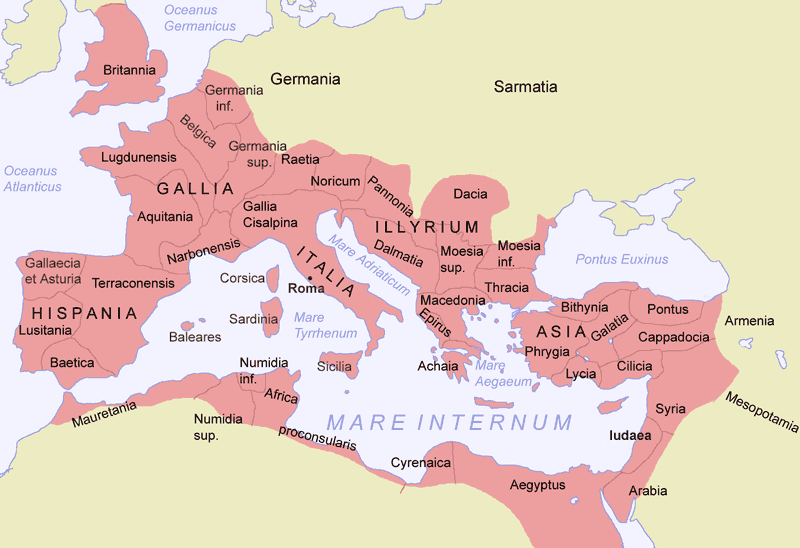
The Roman Empire in 117 A.D., about 84 years after Jesus’ crucifixion. Note the province of Judea, on the lower right side of the map, in roughly the same location as modern-day Israel.

If you want to understand Jesus and the early days of Christianity, then it helps to know about the world Jesus called home.  In particular, it’s important to understand the political backdrop and the relationship between the Jewish people and the Roman Empire.  That understanding will make the Jewish people’s ultimate rejection of Jesus and the Romans’ persecution of early Christians much easier to comprehend.  So, we’ll try to cram hundreds of years of history into a few short paragraphs. Continue reading →

Why Create This Blog?

Let me state up front that I am a Christian, comfortable and secure in my beliefs.  Even though I was raised as a Christian (as a member of the United Methodist Church), I haven’t always been so sure about what I was taught.  Like many people, I had my doubts, first during my high school and college years, and again following the sudden and unexpected death of my father in 2001.

Fact vs. Fairy Tale

However, after 2001, I embarked on a personal quest to learn as much as I could, pro and con, about my faith.  Were the things I had been taught the truth?  Were those teachings well-supported by history and grounded in rational thought?  Or were they basically “fairy tales” to be mined for tidbits of wisdom, but little else?  Continue reading →

Logic, Reason, and the Birth of Our Universe

Many people labor under the misconception that all Christians believe the universe to be a mere 6,000 years old, created by God in the span of 6 days.  After all, that’s what the Bible says, right?  (Not quite, but we’ll save that for another post).  At any rate, those same people often perceive Christians as ignorant and irrational beings with an axe to grind against science, most likely because, in their minds, science has been systematically dismantling Christians’ belief in a “God-myth” for the last several hundred years. Continue reading →